
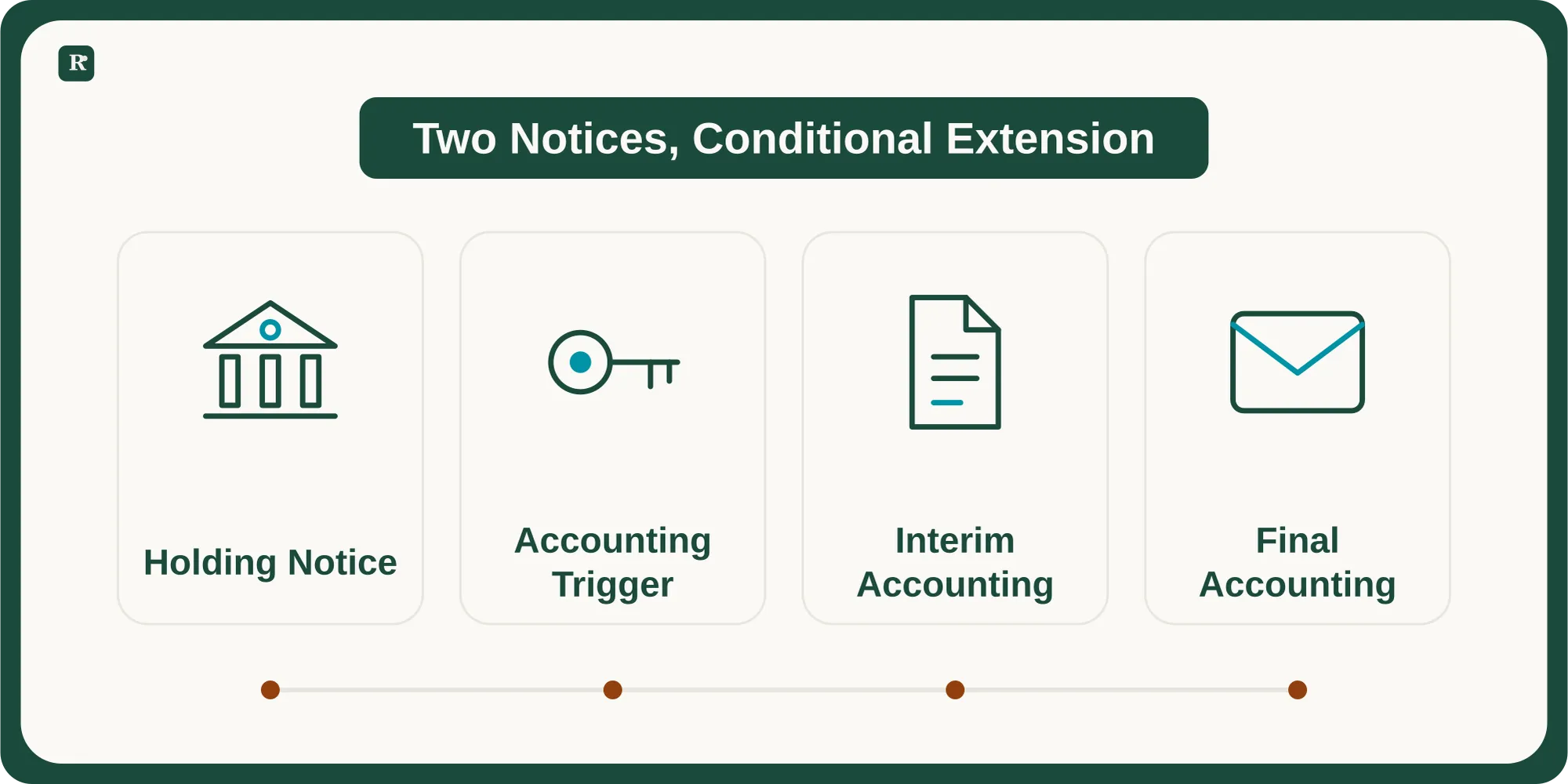
 Two independent clocks frame the article’s notice and accounting questions.
If you take a security deposit on a North Carolina rental, you owe your tenant two disclosures on two separate clocks.
- The first clock runs from the start of the lease term. Within 30 days [1], you tell the tenant where the deposit is held.
- The second clock runs from the end of the tenancy and the return of the unit. Within 30 days [2], you send what you kept and why, together with the balance.
Meeting one deadline buys no time on the other.
Day 60 [2] is available only when you cannot yet determine your claim. Even then, an interim accounting is still due at day 30 [2].
These rules sit in Article 6 of Chapter 42. Article 6 applies to persons, firms or corporations renting or managing residential dwelling units, other than single rooms, on a weekly, monthly or annual basis [3]. An owner who rents a whole unit month to month or on an annual lease falls within that wording [3].
Sequence matters here. If a court finds a failure on the deposit, bond or notice requirements willful, it voids your right to keep any portion of the deposit [4].
State: North Carolina. Statute: N.C. Gen. Stat. §§ 42-50 to 42-56 [3, 4, 5]. Last checked: [EDITOR: insert verification date].
Key takeaways
- Hold the deposit in one of these ways [5]:
- a trust account with a licensed, federally insured depository institution;
- a trust account with a trust institution authorized to do business in North Carolina; or
- a bond from an insurance company licensed in North Carolina.
- Within 30 days after the lease term begins, give the tenant the bank or institution’s name and address, or the bond insurer’s name [1].
- Within 30 days after termination and delivery of possession, send a written itemization of damage with the balance [2].
- Day 60 is for a final accounting only when the extent of your claim cannot be determined by day 30. An interim accounting is still due at day 30 [2].
- Willful failure on the deposit, bond or notice requirements voids your right to keep any portion of the deposit [4].
When are North Carolina’s two deposit notices due?
The bank-or-bond notice is due within 30 days after the lease term begins [1]. The written itemization and deposit balance are due within 30 days after the tenancy ends and possession returns to you [2]. If your claim cannot be determined by then, send an interim accounting by day 30 and a final accounting within 60 days [2].
Before any notice, hold the deposit the way § 42-50 allows
The notice you send later describes how the deposit is held, so that decision comes first. Section 42-50 gives you three options [5]:
| Arrangement | Condition |
|---|---|
| Trust account with a licensed, federally insured depository institution, or with a trust institution authorized to do business in North Carolina | Account held with a qualifying institution [5] |
| Bond from an insurance company licensed to do business in North Carolina | Available at your option instead of a trust account [5] |
| Trust account outside North Carolina | Allowed only if you give the tenant an adequate bond in the amount of the deposits [5] |
Section 42-51(b) caps the amount by tenancy length [6]. These figures are statutory maximums, not recommended amounts:
| Tenancy | Maximum deposit |
|---|---|
| Week to week | Two weeks’ rent [6] |
| Month to month | One and one-half months’ rent [6] |
| Longer than month to month | Two months’ rent [6] |
Whatever you collect must be fully accounted for under § 42-52 [6].
The law does not require the next step, but it helps. Record:
- the institution’s name and address;
- the account type;
- the date you funded the account; and
- the bond issuer, if you use a bond.
Your next notice is built from those facts.
Within 30 days of the lease term starting, tell the tenant where the deposit is held
You or your agent must notify the tenant of one of two things [1]:
- the name and address of the bank or institution where the deposit is currently located; or
- the name of the insurance company providing the bond.
That is the full required content, so keep the notice to those items and add no terms the statute does not ask for.
The clock runs from the beginning of the lease term. Move-in and the day the deposit was paid do not start it [1]. If the lease term begins before move-in, the clock starts on the lease date [1]. As plain arithmetic, a lease term beginning June 1 puts day 30 at July 1, even if the tenant moves in on June 15 [1].
The statute says “notify” and sets a format for the notice nowhere in that wording [1]. A written, dated notice is the version you can produce later if anyone asks. Keeping a copy is your practice, not a legal requirement.
One branch also runs on 30 days. Your interest in the unit may end by sale, assignment, death, appointment of a receiver or otherwise. If it does, § 42-54 gives you 30 days to take one of two steps [7]:
- transfer the remaining deposit, after lawful deductions, to your successor, then notify the tenant by mail of the transferee’s name and address; or
- return the remaining deposit to the tenant.
Either step relieves you of further liability for the deposit [7].
Within 30 days of termination and handover, send the itemization and balance
The walkthrough is done and the keys are back in your hand. What happens next depends on two events, not one: the tenancy has terminated, and possession has been delivered to you [2]. The clock starts only when both are true [2]. So two situations do not start it [2]:
- keys returned while the lease is still running; or
- a lease that ends while the tenant stays on.
By day 30, mail or deliver to the tenant a written itemization of any damage, together with the balance of the deposit [2].
Section 42-51(a) limits what the deposit may cover to eight purposes [8]:
- nonpayment of rent, plus water, sewer or electric charges under the cited utility provisions;
- damage to the premises, including smoke or carbon monoxide alarms;
- damages from nonfulfillment of the rental period;
- unpaid bills that become a lien against the property because of the tenant’s occupancy;
- costs of re-renting after the tenant’s breach, including reasonable broker fees;
- costs of removing and storing the tenant’s property after a summary ejectment;
- court costs; and
- any fee permitted by § 42-46.
The third category has limits. It is barred where the tenant terminated under § 42-45 or § 42-45.1, left because of your violation of Article 2A, or was constructively evicted under § 42-42(a) [8].
Section 42-52 adds two more limits. You may not withhold anything for normal wear and tear, and you may not keep more than your actual damages [9].
If the tenant’s address is unknown, apply the deposit as § 42-51 permits after 30 days. Then hold the balance for the tenant to collect for at least six months [10].
For deduction examples and itemization layout, see NC Security Deposit Return: 30 vs 60 Days.
Day 60 is only for a claim you cannot yet determine
The statute opens the longer window only “if the extent of the landlord’s claim against the security deposit cannot be determined within 30 days” [2]. It is a narrow exception for an open claim, not a general extension.
On that path you owe two documents:
| Deadline after termination and delivery of possession | Document |
|---|---|
| No later than 30 days | Interim accounting [2] |
| Within 60 days | Final accounting [2] |
Skipping the interim accounting and sending one statement at day 60 does not fit the statute’s wording [2].
One example that fits is a utility bill that could become a lien but has not yet arrived, because lien bills are a permitted deduction category [2, 8]. Write down in your file why the claim was still open on day 30. That note is your practice, not the statute’s.
Get a professional review before relying on day 60 in two situations:
- the reason the claim is open is borderline; or
- the tenant is already disputing the amount.
Rules from other states do not carry over:
| State | Window | Trigger and conditions |
|---|---|---|
| North Carolina | 30 days; 60 days for a final accounting on an open claim [2] | Runs from termination and delivery of possession [2]. An unknown address means apply after 30 days and hold the balance at least six months [10] |
| California | 21 days [11] | Runs from move-out. If repairs are not finished for a good reason, send a good-faith estimate, then receipts within 14 days of completion [11] |
| Texas | 30 days [12] | Runs from surrender. No obligation until the tenant gives a written forwarding address [12] |
For how other states treat a short miss, see Missing Deposit Deadlines: What Four States Do. If you also own units across the border, read SC Security Deposit Return: 30-Day Tenant Demand.
 North Carolina; N.C. Gen. Stat. §§ 42-50 and 42-52; last-checked date awaiting editorial verification. Source: https://www.ncleg.gov/EnactedLegislation/Statutes/HTML/ByArticle/Chapter_42/Article_6.html
In a dispute, willfulness sets what is at stake
If you do not account for and refund the balance as Article 6 requires, the tenant may file a civil action. The action can force an accounting and recover the balance [4].
Willful failure on the deposit, bond or notice requirements voids your right to keep any portion of the deposit that § 42-51 would otherwise allow [4]. The § 42-50 bank-or-bond notice is one of those notice requirements [1, 4].
The tenant may also recover damages caused by your failure to comply [4]. If the court finds willful failure, it may award attorney’s fees, taxed as costs of court [4].
The statute leaves willfulness to the court [4]. A record can show when each notice went out and what it said. If a tenant alleges a missed notice, have a North Carolina attorney review the file before you respond.
 Entered records preserve dates and documents; a North Carolina attorney reviews disputed interpretation.
FAQ
Does the 30-day bank notice start at move-in? No. It runs from the beginning of the lease term [1].
Can I send everything at day 60 instead? Only the final accounting can wait, and only on the open-claim path. The interim accounting is still due by day 30 [2].
What if the tenant left no forwarding address? Apply the deposit as § 42-51 permits after 30 days, then hold the balance at least six months [10].
What this does not cover
The quoted statutory text does not define “cannot be determined” [2], and whether a particular claim qualified is a question for a North Carolina attorney.
What now
Your aim is a file that shows, by date, that each North Carolina notice went out on the right clock. To keep the bank-or-bond notice, the day-30 itemization or interim accounting, and any day-60 final accounting in one place, start a North Carolina decision record. It stores the dates and documents you enter. It does not decide whether your claim was determinable, and it does not predict how a court will read willfulness.
Sources
Bracketed numbers point to the sources below. Where several numbers appear together, the statement is our reading across those sources.
- Under N.C. Gen. Stat. § 42-50, the landlord or landlord’s agent must notify the tenant within 30 days after the beginning of the lease term of the name and address of the bank or institution where the tenant’s deposit… https://www.ncleg.gov/EnactedLegislation/Statutes/HTML/ByArticle/Chapter_42/Article_6.html
- Under N.C. Gen. Stat. § 42-52, upon termination of the tenancy, the landlord must itemize any damage in writing and mail or deliver it to the tenant along with the balance of the security deposit no later than 30 days… https://www.ncleg.gov/EnactedLegislation/Statutes/HTML/ByArticle/Chapter_42/Article_6.html
- Under N.C. Gen. Stat. § 42-56, the North Carolina Tenant Security Deposit Act (Article 6) applies to all persons, firms, or corporations engaged in the business of renting or managing residential dwelling units… https://www.ncleg.gov/EnactedLegislation/Statutes/HTML/BySection/Chapter_42/GS_42-56.html
- Under N.C. Gen. Stat. § 42-55, a landlord’s willful failure to comply with the deposit, bond, or notice requirements of Article 6 voids the landlord’s right to retain any portion of the tenant’s security deposit as… https://www.ncleg.gov/EnactedLegislation/Statutes/HTML/BySection/Chapter_42/GS_42-55.html
- Under N.C. Gen. Stat. § 42-50, residential tenant security deposits in North Carolina must be deposited in a trust account with a licensed and federally insured depository institution or a trust institution authorized… https://www.ncleg.gov/EnactedLegislation/Statutes/HTML/ByArticle/Chapter_42/Article_6.html
- Under N.C. Gen. Stat. § 42-51(b), the statutory maximum security deposit in North Carolina is capped by tenancy length at two weeks’ rent for week-to-week tenancies, one and one-half months’ rent for month-to-month… https://www.ncleg.gov/EnactedLegislation/Statutes/HTML/ByArticle/Chapter_42/Article_6.html
- Under N.C. Gen. Stat. § 42-54, upon termination of the landlord’s interest in a dwelling unit by sale, assignment, death, appointment of receiver, or otherwise, the landlord or agent must within 30 days either (1)… https://www.ncleg.gov/EnactedLegislation/Statutes/HTML/ByArticle/Chapter_42/Article_6.html
- Under N.C. Gen. Stat. § 42-51(a), permitted uses of a residential security deposit in North Carolina are restricted to eight enumerated categories: (1) nonpayment of rent and costs for water or sewer services under G.S. https://www.ncleg.gov/EnactedLegislation/Statutes/HTML/ByArticle/Chapter_42/Article_6.html
- Under N.C. Gen. Stat. § 42-52, a North Carolina landlord is prohibited from withholding any part of the security deposit for conditions due to normal wear and tear or retaining an amount that exceeds actual damages… https://www.ncleg.gov/EnactedLegislation/Statutes/HTML/ByArticle/Chapter_42/Article_6.html
- Under N.C. Gen. Stat. § 42-52, if the tenant’s address is unknown after termination of the tenancy, the landlord must apply the deposit as permitted in G.S. https://www.ncleg.gov/EnactedLegislation/Statutes/HTML/ByArticle/Chapter_42/Article_6.html
- In California (under Civil Code § 1950.5, as summarized by the California Courts Self-Help Guide), a landlord has 21 days after a tenant moves out to return the full security deposit or provide an itemized statement… https://selfhelp.courts.ca.gov/guide-security-deposits-california
- In Texas (under Texas Property Code §§ 92.103, 92.104, and 92.109), a landlord must refund a security deposit or provide a written description and itemized list of deductions on or before the 30th day after the tenant… https://guides.sll.texas.gov/landlord-tenant-law/security-deposits