
Key takeaways
- North Carolina General Statutes Chapter 42 now reflects all legislative amendments through S.L. 2026-30, as of October 2026 [1].
- Review your lease against Chapter 42 to confirm no clause contradicts a statutory duty.
- Four duty areas warrant close review: ongoing habitability, written-notice repair triggers, alarm hardware and 15-day response windows, and security-deposit accounting tied to possession rather than lease expiration.
- Review each area before your next lease-up and document every duty trigger with a dated, retrievable record.
If you self-manage one to five residential rental units in North Carolina, your lease template is measured against one benchmark: North Carolina General Statutes Chapter 42 as currently codified. As of October 2026, that text incorporates all legislative amendments through S.L. 2026-30 [1]. Any clause that contradicts a Chapter 42 duty should be reviewed with qualified counsel for its enforceability and effect. That review is what makes a lease audit a useful step before every lease-up, not a once-a-decade project.
This article walks through four Chapter 42 duty areas most likely to contain a gap in a standard lease template, identifies a key clause concern in each area, and shows what a corrected clause looks like.
Habitability: ‘As-Is’ Language and § 42-42
Under N.C. Gen. Stat. § 42-42(a)(2), you must make all repairs and do whatever is necessary to put and keep the premises in a fit and habitable condition [2]. The word “keep” carries the weight here. The duty is ongoing: handing over clean keys on move-in day satisfies it for that moment, not for the tenancy.
Our reading: a lease clause reading “tenant accepts premises as-is” creates a direct contradiction between your lease and § 42-42(a)(2), and that contradiction should be reviewed with qualified counsel before you rely on it in any dispute. Remove any as-is or habitability-waiver clause from your template. You do not need to draft an elaborate affirmative-duty paragraph in its place; you need to ensure nothing in your lease says the opposite of § 42-42(a)(2).
The repair mechanism under § 42-42(a)(4) layers a procedural trigger on top of the substantive duty: for non-emergency conditions, your obligation clock does not start until the tenant provides written notification of needed repairs [3]. Our reading: a verbal complaint alone may not satisfy the written-notification requirement in § 42-42(a)(4), but whether any particular communication qualifies is a question for qualified counsel. That distinction is useful to you, but only if your lease identifies a specific written-notice method. If your lease says only “notify landlord,” you have created ambiguity about when your obligation begins. Add a clause specifying the exact submission method: a designated email address, a dated maintenance-request form, or a written letter. Keep a dated log of every submission received [2, 3].
This article does not give guidance on how maintenance records interact with security deposit deductions; confirm that question with your North Carolina attorney or a qualified property-management adviser. In addition to physical unit maintenance, landlords holding tenant funds must strictly adhere to North Carolina security deposit trust account disclosures under N.C. Gen. Stat. § 42-50 before lease inception.
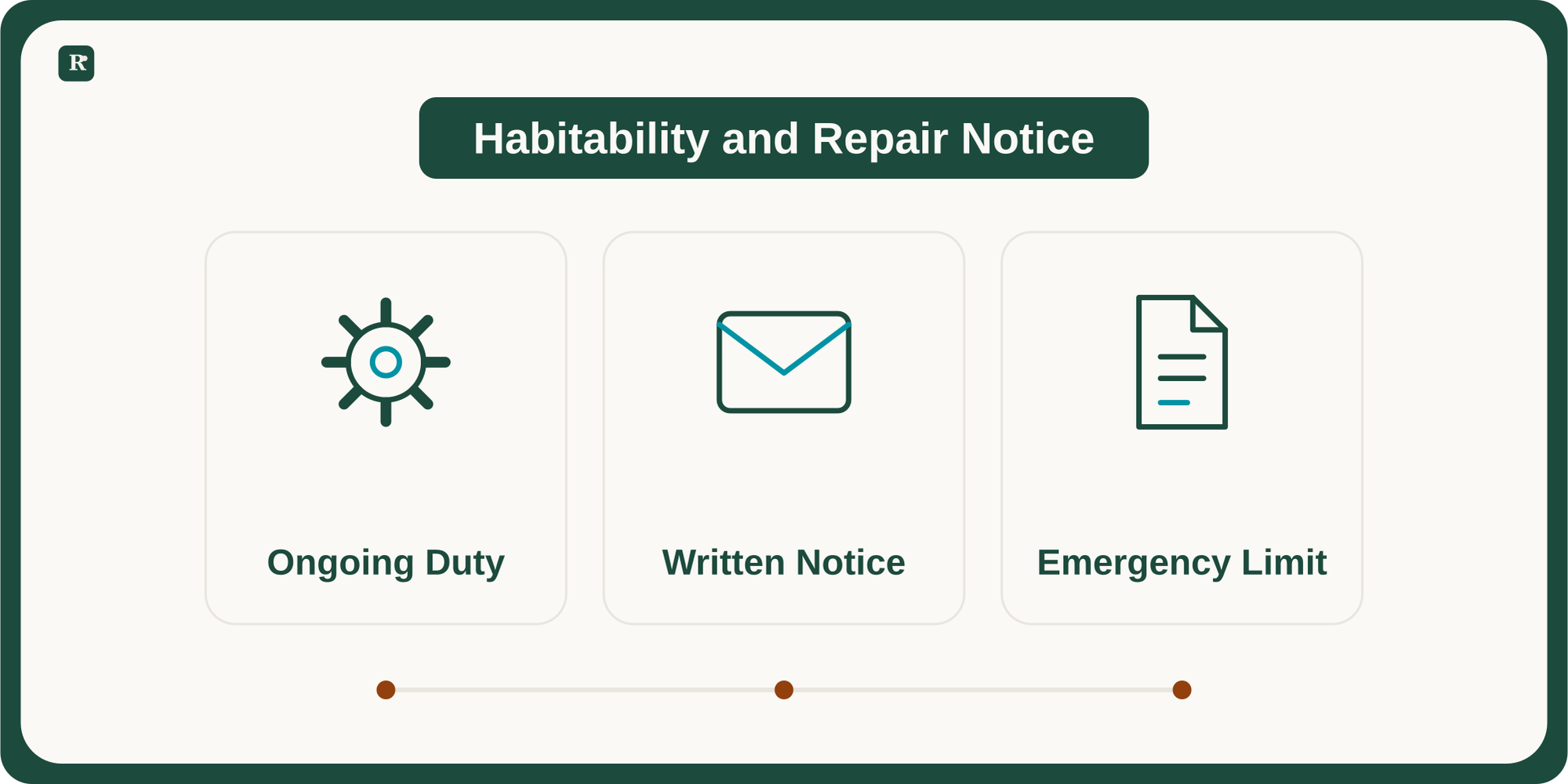 North Carolina, § 42-42(a)(2) and (4); article-supplied rule-check period: October 2026. The written-notice condition has an emergency exception.
Alarm Hardware and Response: Two 15-Day Clocks Running From Written Notice
Chapter 42 sets both hardware standards and response deadlines for smoke alarms and carbon monoxide alarms. Your lease must be consistent with both.
Smoke alarms. Under § 42-42(a)(5), you must ensure a smoke alarm is operable and in good repair at the beginning of each tenancy [4]. If the tenant notifies you in writing that replacement or repair is needed, you must replace or repair within 15 days of receipt of that written notification [4]. The 15-day clock starts on the date you receive the written notice, not the date you schedule a repair visit. When you replace or install a new smoke alarm, § 42-42(a)(5a) requires a tamper-resistant, 10-year lithium battery smoke alarm for any installation or replacement after December 31, 2012 [5]. Two exceptions apply: the unit already has a hardwired smoke alarm with battery backup, or the unit has a combined smoke and carbon monoxide alarm [5].
Carbon monoxide alarms. Under § 42-42(a)(7), you must provide a minimum of one operable CO alarm per rental unit per level in any dwelling unit that has a fossil-fuel burning heater, appliance, or fireplace, or an attached garage [6]. The same 15-day repair clock applies: written tenant notice starts the window [6]. If your unit has any fossil-fuel burning heater, appliance, or fireplace, or an attached garage, confirm that your CO alarm coverage and your lease’s alarm-maintenance clause both reflect § 42-42(a)(7) [5, 6].
Your lease should specify the written-notice method that starts the alarm-repair clock. A clause that requires only that the tenant “report” an alarm problem, without identifying a written form and a delivery method, leaves the start date of the 15-day window uncertain for both parties. Add the clause; add the log.
Security Deposit Accounting: The Clock Starts on Possession, Not Lease Expiration
Under N.C. Gen. Stat. § 42-52, you must mail or deliver a written itemization of any damage and the balance of the security deposit no later than 30 days after termination of the tenancy and delivery of possession of the premises to you [7]. If the full claim cannot be determined within 30 days, you must deliver an interim accounting at the 30-day mark and a final accounting within 60 days after termination and delivery of possession [7].
The possession trigger is where lease templates most commonly create magistrate-court exposure. The 30-day clock does not start when the lease expires on paper. Under § 42-52, it starts upon termination of the tenancy and delivery of possession [7]. A tenant who delays return of possession extends the date from which the statutory window runs, and your accounting window does not begin until both termination and delivery of possession have occurred [7]. Document the date possession is returned to you — a dated written confirmation, a signed key-receipt form, or a timestamped email — so the start of your 30-day and 60-day windows is clear.
The most dangerous lease clause in this area ties the accounting deadline to lease expiration rather than delivery of possession. If your lease says the landlord will return the deposit within 30 days of the lease end date, and the tenant holds over or delays, your clause and the statute describe different start dates. Confirm the effect of any such clause with qualified counsel before relying on it [1, 7].
If you want to understand what happens when a comparable statutory deadline is missed, confirm penalty mechanics with your North Carolina attorney; this article does not cover multi-state penalty comparisons. For complete timelines, allowable deductions, and interim accounting requirements under N.C. Gen. Stat. § 42-52, consult our statutory guide on North Carolina security deposit itemization rules.
 The possession record and accounting paperwork remain linked in the article’s move-out recordkeeping scene.
The Four-Gap Audit: One Table, One Fix Per Duty Area
A lease audit against Chapter 42 is a structured comparison, not a tone review. The table below identifies a key clause concern in each of the four duty areas and the specific fix [1, 2, 3, 4, 5, 6, 7].
| Duty area | Statute | Most dangerous gap | Fix |
|---|---|---|---|
| Habitability | § 42-42(a)(2) | Any “as-is” or waiver clause that contradicts the ongoing repair duty | Remove the clause; ensure nothing in your lease contradicts the continuing obligation [2] |
| Repair-notice trigger | § 42-42(a)(4) | Clause requiring only that the tenant “notify” the landlord, with no written-form requirement | Add a clause identifying the exact written submission method that starts the obligation clock; log every request [3] |
| Alarm hardware and response | § 42-42(a)(5), (5a), (7) | No clause addressing the 15-day repair obligation or the written-notice trigger that starts it | Add a clause requiring written alarm-defect notice, cite the 15-day window, and confirm hardware meets tamper-resistant 10-year lithium battery standard or a qualifying exception [4, 5, 6] |
| Security deposit accounting | § 42-52 | Deadline tied to lease expiration rather than delivery of possession | Revise to track the possession trigger; add a documented possession-return step to your move-out process [7] |
What a Lease Audit Looks Like in Practice
After working through the four duty areas above, two conditions should hold. First, every clause in your lease template is reviewed against Chapter 42 as codified through S.L. 2026-30 [1]: no clause contradicts a statutory duty, and no clause ties a statutory deadline to a non-statutory trigger. Second, your operational records — maintenance request logs, alarm inspection notes, possession-return confirmations — give you a dated, reconstructable account of how you met each duty.
That second condition matters if a tenant disputes a deduction, raises a habitability question, or challenges a repair timeline: a dated record for each duty trigger shows when you received written notice and when you acted. The lease audit closes the document gap. The operational record closes the evidentiary gap. Both are within reach before your next lease-up.
Sources
Bracketed numbers point to the sources below. Where several numbers appear together, the statement is our reading across those sources.
- North Carolina General Statutes Chapter 42 currently reflects changes through S.L. 2026-30, meaning the codified landlord-tenant framework as of October 2026 incorporates all legislative amendments enacted through that… https://www.ncleg.gov/Laws/GeneralStatuteSections/Chapter42
- Under N.C. Gen. Stat. § 42-42(a)(2), a North Carolina landlord must make all repairs and do whatever is necessary to put and keep the premises in a fit and habitable condition. https://www.ncleg.gov/EnactedLegislation/Statutes/HTML/BySection/Chapter_42/GS_42-42.html
- Under N.C. Gen. Stat. § 42-42(a)(4), the landlord’s duty to promptly repair electrical, plumbing, sanitary, heating, ventilating, air conditioning, and other facilities is triggered only after the tenant provides… https://www.ncleg.gov/EnactedLegislation/Statutes/HTML/BySection/Chapter_42/GS_42-42.html
- Under N.C. Gen. Stat. § 42-42(a)(5), the landlord must replace or repair smoke alarms within 15 days of receiving written notification from the tenant that replacement or repair is needed, and must ensure smoke alarms… https://www.ncleg.gov/EnactedLegislation/Statutes/HTML/BySection/Chapter_42/GS_42-42.html
- Under N.C. Gen. Stat. § 42-42(a)(5a), when installing a new smoke alarm or replacing an existing one after December 31, 2012, the landlord must install a tamper-resistant, 10-year lithium battery smoke alarm, unless the… https://www.ncleg.gov/EnactedLegislation/Statutes/HTML/BySection/Chapter_42/GS_42-42.html
- Under N.C. Gen. Stat. § 42-42(a)(7), landlords must provide a minimum of one operable carbon monoxide alarm per rental unit per level in any dwelling unit with a fossil-fuel burning heater, appliance, or fireplace, or… https://www.ncleg.gov/EnactedLegislation/Statutes/HTML/BySection/Chapter_42/GS_42-42.html
- Under N.C. Gen. Stat. § 42-52, upon termination of tenancy a North Carolina landlord must mail or deliver a written itemization of any damage and the balance of the security deposit no later than 30 days after… https://www.ncleg.gov/EnactedLegislation/Statutes/HTML/BySection/Chapter_42/GS_42-52.html