
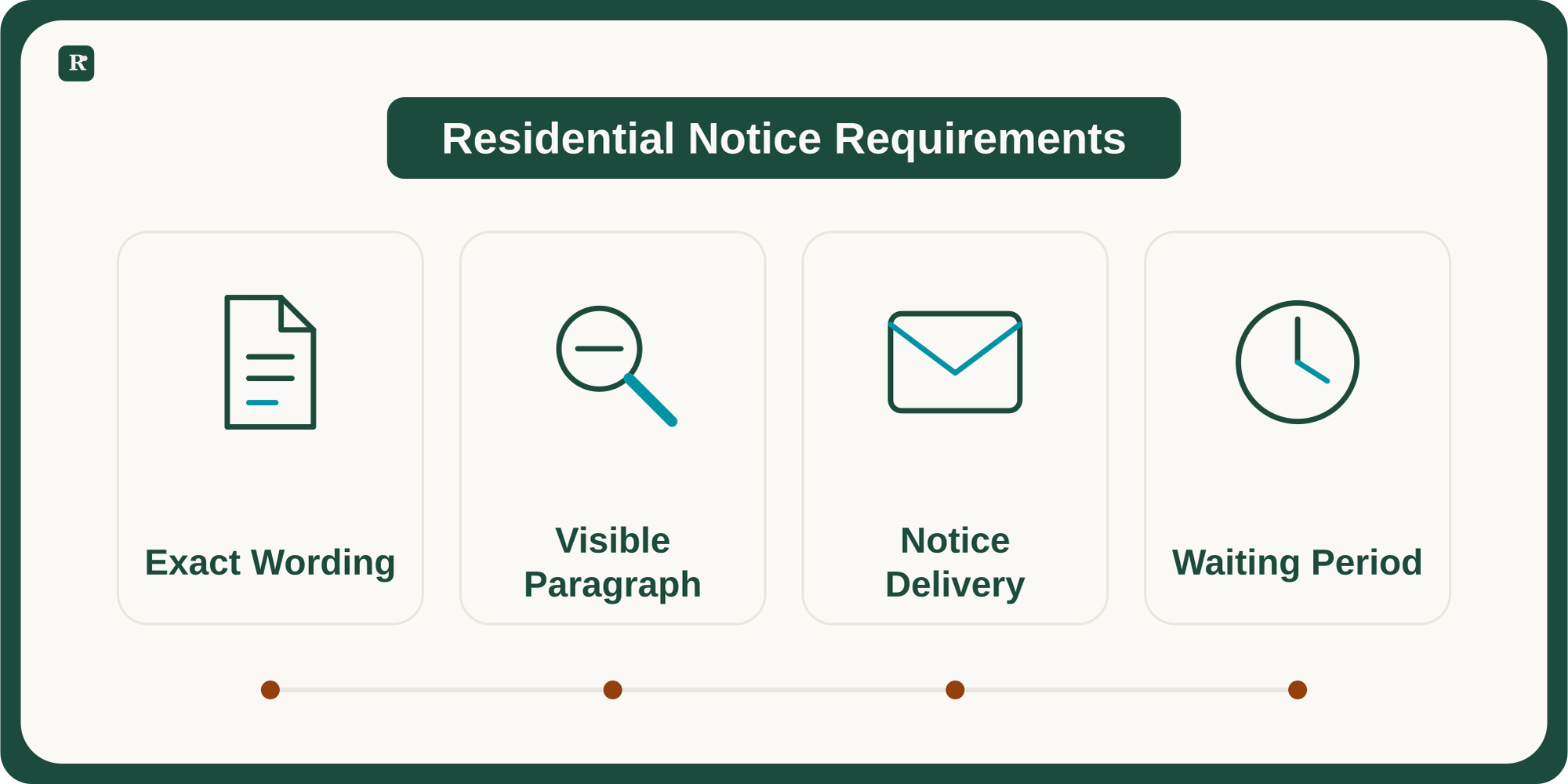
Quick answer: Before you can file an eviction action in Ohio, you must serve a written notice giving the tenant at least three days to leave [1]. Every landlord-issued residential notice must contain one specific statutory paragraph printed conspicuously [2]. Service must use one of three authorized delivery methods [3]. This guide covers each requirement, the interpretive disputes courts and practitioners handle differently, and the filing-stage obligation that catches self-managing landlords off guard.
Key Takeaways
- The statute requires you to notify the tenant at least three days before commencing the action [1].
- The mandatory statutory paragraph must appear conspicuously on every landlord-initiated notice to recover residential premises [2].
- Only three delivery methods are authorized under ORC § 1923.04 [3].
- A written complaint particularly describing the premises must be filed before any summons issues [4].
- If you are also terminating a month-to-month tenancy, a separate 30-day notice under ORC § 5321.17 applies in addition to the 3-day notice [5].
The Three-Day Waiting Period Is a Hard Floor With a Disputed Start Date
Ohio’s eviction statute requires you to notify the tenant to leave the premises at least three days before you commence the action [1]. The outer rule is settled. Where practitioners diverge is when Day One begins—and that ambiguity carries real dollar risk for a self-managing landlord without legal backup.
Certified mail and the return receipt date. When you send the notice by certified mail with return receipt requested, that method is authorized under ORC § 1923.04 [3]. Our reading: the three-day clock runs from confirmed delivery rather than the date you handed the envelope to the postal carrier, and retaining the return receipt card is the practical record of that date. Use the receipt date to calculate your earliest permissible filing date.
Posting at the premises and the clock-start ambiguity. Leaving a copy at the tenant’s usual place of abode or at the subject premises is authorized [3]. This article does not state when service is complete for a posted notice; confirm the current judicial treatment of that question with your Ohio counsel before relying on this method. Because that question is unsettled, the defensive posture is to add at least one buffer day beyond the three-day minimum and photograph the posted notice in place with a date-and-time stamp.
Nonpayment, breach, and holdover: the waiting period does not change. Ohio’s eviction statute permits proceedings against tenants holding over their terms, tenants in default in the payment of rent under an oral tenancy, and tenants who have breached a written rental agreement [6]. The three-day pre-filing notice requirement applies before commencing any of those actions [1].
Month-to-month termination is a separate and longer obligation. If you are also ending a month-to-month tenancy—not merely pursuing unpaid rent—ORC § 5321.17 imposes a separate notice of at least thirty days prior to the periodic rental date [5]. The thirty-day termination notice and the three-day notice to leave serve different statutory functions under ORC § 5321.17 and ORC § 1923.04 respectively [1][5].
Scope note: ORC § 1923.04 governs standard residential tenancies. If you manage HUD, Section 8, or other federally assisted housing, federal program rules may impose different or additional notice requirements. Confirm those requirements separately before relying solely on the state statutory framework.
The Mandatory Statutory Paragraph: Verbatim, Conspicuous, No Exceptions
Every notice you give as a landlord to recover residential premises under ORC § 1923.04 must contain the following language, printed or written in a conspicuous manner [2]:
“You are being asked to leave the premises. If you do not leave, an eviction action may be initiated against you. If you are in doubt regarding your legal rights and obligations as a tenant, it is recommended that you seek legal assistance.”
Three sub-elements each operate independently.
Verbatim text. The statute specifies the exact words [2]. Paraphrasing, condensing, or modernizing the language does not satisfy the requirement. Our reading: courts treat deviation from the statutory text as a defect on the face of the notice; consult Ohio counsel if your current form uses anything other than the exact statutory language.
Printed conspicuously. This is where interpretive variance lives. The statute uses the word “conspicuous” without defining it [2]. This article does not state a minimum font size, color contrast, or exact placement requirement; confirm the current judicial standard with your Ohio counsel. A landlord who buries the paragraph in normal-weight body text at the bottom of the notice faces a fact-specific challenge. Use bold typeface, a readable font size, and visual separation from the surrounding text as a practical safeguard.
Present on every landlord-initiated notice. The statute says “every notice given under this section by a landlord to recover residential premises” [2]. The statute covers oral tenancies, written rental agreement breaches, and holdover situations [6].
For context: a separate mandatory paragraph also appears on the court-issued eviction summons under ORC § 1923.06 [7]. That is a court document—you do not draft it. Its existence does not remove your notice-drafting obligation.
 Ohio — ORC § 1923.04. Source check date was not supplied; confirm it before publication.
Three Authorized Delivery Methods—Email and Text Are Not on the List
ORC § 1923.04 authorizes exactly three methods of service [3]. All three are legally valid; they differ in the quality of proof they produce and, as discussed above, in how the clock-start date is established.
| Method | Proof quality | Clock-start point | Key action for your file |
|---|---|---|---|
| Certified mail, return receipt requested | Third-party timestamped record | Date shown on return receipt card | Retain the green receipt card with the notice copy |
| Personal hand delivery to tenant | Direct delivery on the date it occurs | Date of hand delivery | Write a brief dated note: time, location, description of the exchange |
| Leaving copy at usual place of abode or premises | Thinner evidentiary record | Confirm with Ohio counsel | Photograph notice in place with date-and-time stamp |
The three authorized methods are certified mail with return receipt requested, personal hand delivery, and leaving a copy at the defendant’s usual place of abode or at the subject premises [3]. If you have communicated with your tenant exclusively by email throughout the tenancy, that channel still cannot carry the statutory notice. Serving by a non-authorized method does not start the three-day clock.
Understanding how tenant documentation practices affect eviction defensibility before a dispute escalates is part of the same record-keeping discipline that matters at the notice stage.
Filing the Written Complaint: A Fourth Independent Defect Point
The notice phase covers three requirements. A fourth obligation arises at the courthouse and can independently defeat an otherwise-valid notice.
Ohio law requires you to file a written complaint before any summons issues [4]. The complaint must particularly describe the rental premises—street address, unit number, and any description sufficient to identify the specific unit [4]. A vague or generic address description is a separate defect from the notice requirements; ORC § 1923.05 requires particular description as a condition of the complaint [4].
Once the written complaint is filed, the court generates the summons. That summons must be served at least seven days before the trial date [8], and the process server must return proof of service to the clerk within five days of receiving it [9]. Confirming those steps have been satisfied is still part of verifying your case is on a valid procedural track—a practical check that belongs in your file.
The decision record you build during the notice and service phase—service date, method used, photograph or return receipt card, earliest permissible filing date—is the same record you need if the tenant raises a procedural defense at the eviction hearing or the clerk questions timeliness at filing.
 The dashed sheet separates the court-issued summons from the reader’s retained records.
FAQ
Can I use email to serve the 3-day notice if that is how I communicate with my tenant? No. The three authorized methods under ORC § 1923.04 are certified mail with return receipt requested, personal hand delivery, and leaving a copy at the usual place of abode or premises [3]. Use one of those three methods.
Does the mandatory paragraph need to be in bold? The statute requires it to be printed “in a conspicuous manner” [2]. This article does not state a minimum font size or placement standard; confirm the current judicial standard with your Ohio counsel. Bold typeface with visual separation from surrounding text is a practical safeguard given the plain meaning of “conspicuous.”
If the tenant pays part of the rent after I serve the notice, does that void the notice? This article does not give an answer on partial payment after service; confirm that question with your Ohio counsel before you file, as accepting partial payment can affect your right to proceed.
I have a month-to-month tenant who has not paid rent. Do I need both a 30-day notice and a 3-day notice? They serve different functions. The 3-day notice is a pre-filing requirement for the eviction action [1]. The 30-day notice under ORC § 5321.17 is required to terminate the tenancy itself [5]. Which you need—and in what sequence—depends on your grounds and objective. If you are pursuing unpaid rent without terminating the tenancy, consult Ohio counsel on whether both are required in your specific fact pattern.
What happens to the summons after I file the complaint? The court issues the summons, which must contain its own separate statutory paragraph under ORC § 1923.06 [7]. Summons service must occur at least seven days before the trial date [8]. The process server returns proof of service within five days of receiving the summons from the clerk [9]. You do not draft or serve the summons—that is the court’s function.
What this does not cover
This article addresses standard residential tenancies governed by ORC § 1923.04 [1]. It does not address commercial tenancies, government-subsidised or federally assisted residential tenancies, or mobile home park evictions, which may be subject to different statutory requirements. The conspicuousness standard and the certified-mail clock-start rule involve areas where authority is derived rather than directly stated [1, 3]; a landlord facing a contested hearing on either point should consult Ohio counsel.
Building a dated, method-specific proof-of-service record before you walk into the courthouse is the step that keeps a procedurally sound notice from being challenged on a technicality.
Sources
Bracketed numbers point to the sources below. Where several numbers appear together, the statement is our reading across those sources.
- Before filing an eviction action in Ohio, a landlord must notify the tenant to leave the premises at least three days before commencing the action. https://codes.ohio.gov/ohio-revised-code/section-1923.04
- Every 3-day notice served by a landlord to recover residential premises must include a specific statutory warning paragraph printed or written in a conspicuous manner. https://codes.ohio.gov/ohio-revised-code/section-1923.04
- Ohio law provides three permissible methods for serving a 3-day notice: certified mail with return receipt requested, personal hand delivery to the defendant, or leaving a copy at the defendant’s usual place of abode or… https://codes.ohio.gov/ohio-revised-code/section-1923.04
- An Ohio eviction complaint must be filed in writing and must particularly describe the premises; no summons issues until the written complaint is filed with the court. https://codes.ohio.gov/ohio-revised-code/section-1923.05
- For a month-to-month tenancy in Ohio, a landlord must give at least 30 days’ notice prior to the periodic rental date to terminate or fail to renew the tenancy; https://codes.ohio.gov/ohio-revised-code/section-5321.17
- Ohio’s eviction statute permits proceedings against tenants holding over their terms and against tenants in default in the payment of rent under an oral tenancy, as well as against tenants who have breached a written… https://codes.ohio.gov/ohio-revised-code/section-1923.02
- Every eviction summons issued to recover residential premises in Ohio must itself contain a separate mandatory statutory paragraph printed in a conspicuous manner, distinct from the notice language required by ORC §… https://codes.ohio.gov/ohio-revised-code/section-1923.06
- Service of the eviction summons must occur at least seven days before the trial date set by the court. https://codes.ohio.gov/ohio-revised-code/section-1923.06
- After a process server receives the eviction summons from the clerk, they must return proof of service to the clerk within five days. https://codes.ohio.gov/ohio-revised-code/section-1923.06