
New York’s security deposit statute is not a single deadline. For self-managing landlords of non-rent-stabilized residential units, GOL Section 7-108(1-a) runs from the day you collect the first dollar of deposit through the day you account for the last. The statute operates as four sequential gates. Each gate closes a right or opens the next. Miss any one of them—not just the final 14-day deadline—and your legal position at the end is weaker than it needs to be, regardless of how strong your underlying damage evidence looks.
This guide maps every gate in order, states the specific obligation at each one, and shows how the documentary record you build along the way becomes the substance of your defense if a tenant disputes your deductions.
Key takeaways
- The deposit is capped at one month’s rent before the tenancy begins. [1]
- You must offer a written move-in condition agreement before occupancy; any defect recorded there cannot later support a deduction. [2]
- Once either party signals termination, you must send a written notice of the tenant’s inspection rights within a reasonable time—before the tenant asks. [3]
- If the tenant requests a walkthrough, it must occur in the two-week-to-one-week window before move-out, with 48 hours written notice from you. [4]
- Within 14 days of actual vacancy, you must return any remaining deposit and deliver an itemized statement. [5]
- Miss the 14-day deadline and you forfeit every dollar of the deposit, automatically, regardless of the damage evidence you hold. [6]
- In any dispute, you bear the burden of proving the reasonableness of every amount you retained. [7]
- Willful violation exposes you to punitive damages of up to twice the deposit, on top of actual damages. [8]
Gate 1: Cap the Deposit and Execute a Move-In Condition Agreement Before Occupancy
The statute sets two obligations before the tenancy begins. Both are yours to initiate.
First, the cap: for non-rent-stabilized residential units, no security deposit or advance may exceed one month’s rent. [1] Collecting more than one month does not give you a larger cushion—it gives the tenant a statutory violation to raise against you from day one.
Second, the move-in inspection: before the tenant begins occupancy, you must offer them the opportunity to inspect the premises with you or your agent. [2] If the tenant accepts, both parties must execute a written agreement attesting to the condition of the property and specifically noting any existing defects or damage, signed before occupancy begins. [2] Upon vacancy, you may not retain any portion of the deposit for any condition, defect, or damage recorded in that agreement. [2]
The move-in agreement works the way a car-rental agent’s condition diagram works before you drive off the lot: the scratch that existed before the rental cannot become your liability when you return the keys. Under GOL Section 7-108(1-a)(f), you carry the burden of proof in a deposit dispute. [7] A landlord who skips the move-in documentation cannot later argue that a pre-existing crack was caused by the departing tenant. The baseline is either recorded in writing or it does not exist when challenged.
The move-in condition agreement is also admissible as evidence in any proceeding about the return or amount of the security deposit. [2] That evidentiary function alone makes it worth the ten minutes it takes to produce.
Gate 2: Send a Written Inspection-Rights Notice the Moment Termination Is Signaled
The pre-move-out inspection regime begins when either party gives notice of intent to terminate. Many self-managing landlords are unaware this obligation exists until they are already past it.
Within a reasonable time after notification of either party’s intention to terminate—whether you serve a non-renewal notice or the tenant hands you a move-out letter—you must notify the tenant in writing of the right to request a pre-move-out inspection and the right to be present at that inspection. [3] This is a landlord-initiated notice obligation. You do not wait for the tenant to ask; you tell them the right exists.
The written notice obligation is excused in exactly one circumstance: when the tenant terminates the tenancy with less than two weeks’ notice. [3] Every other scenario requires the written notice.
If you fail to send it, the inspection framework and the cure opportunity it creates cannot be properly triggered. That means you lose your earliest chance to document conditions, put the tenant on notice of proposed deductions, and give them the opportunity to fix problems before they become litigation points. The obligation is procedural, but its downstream consequences are financial.
Gate 3: Schedule the Walkthrough Within the Statutory Window and Deliver a Written Deficiency List
The walkthrough is the tenant’s right to invoke. Once invoked, the scheduling mechanics and the post-inspection itemization become your hard obligations.
If the tenant requests an inspection, it must be scheduled no earlier than two weeks and no later than one week before the end of the tenancy. [4] You must provide the tenant with at least 48 hours written notice of the date and time. [4] Both the scheduling window and the written notice requirement are fixed. A phone call does not substitute for written notice, and the inspection cannot be held outside the statutory window.
After the inspection, you must provide the tenant with an itemized statement specifying the repairs or cleaning you propose to deduct from the deposit. [9] The tenant must then have the opportunity to cure any condition identified in that statement before the end of the tenancy. [9]
The cure mechanism matters in practice: a tenant who repairs a wall hole or professionally cleans a carpet before vacating eliminates your basis for that deduction. A landlord who issues a written deficiency list, photographs the uncured condition at move-out, and attaches dated invoices for the repair carries a far stronger record than one who relies on move-out photographs alone with no pre-established documented baseline.
Note that the post-inspection itemized statement is a separate document from the final 14-day accounting. [5, 9] The post-inspection list addresses conditions the tenant still has time to cure; the final accounting reflects actual move-out conditions and the costs of any uncured or new damage.
 Inspection findings and final accounting occupy separate stages in the article.
Gate 4: Return the Deposit and Deliver an Itemized Statement Within 14 Days of Actual Vacancy
The 14-day clock is the statute’s hard deadline. It starts when the tenant has vacated the premises—not when the lease term expires on paper, not when the tenant mails the keys, not when the last month’s rent clears. [5]
Within 14 days of actual vacancy, you must provide the tenant with an itemized statement indicating the basis for any amount retained and return any remaining portion of the deposit. [5]
If you fail to provide the statement and return the deposit within 14 days, you forfeit any right to retain any portion of the deposit. [6] The forfeiture is automatic and mandatory upon failure to meet the deadline. [6] There is no judicial discretion to excuse a late accounting, and the statute contains no tolling provision in its text. [5, 6]
The consequence is routinely underestimated. A landlord with documented, legitimate, and substantial damage claims loses the right to retain any amount if the itemized accounting arrives on day 15. Mark the deadline in your calendar on the day the tenant surrenders possession—not after you have assessed the unit, not after you have collected contractor quotes. The assessment and the quotes must happen inside the 14-day window.
What Happens When You Miss a Gate: Burden of Proof, Actual Damages, and Punitive Exposure
The statute’s enforcement framework is the direct consequence of missing a gate, not a separate track running alongside it.
In any action or proceeding disputing the amount of deposit retained, you bear the burden of proving the reasonableness of every dollar you kept. [7] That burden cannot be met with recollection. It requires the move-in condition agreement, the written inspection-rights notice, the post-inspection itemized deficiency list, the 48-hour written inspection scheduling notice, and the final itemized accounting with supporting invoices. Each of those is a document the statute either requires or that directly supports your ability to meet the reasonableness standard.
Any violation of GOL Section 7-108(1-a) exposes you to actual damages. [8] A willful violation exposes you to punitive damages of up to twice the amount of the deposit or advance, on top of actual damages. [8] The line between the two exposures turns on willfulness—and willfulness is easier to infer once a landlord has documented knowledge of the statute’s requirements. A pattern of non-adherence after acquiring that knowledge is a different evidentiary position from a first-time procedural error made in genuine ignorance.
For self-managing landlords handling their own units without a property manager, the practical risk is not forgetting the law. It is being unable to reconstruct the sequence when challenged. The statute requires written notices at multiple stages, specific timing at each stage, and an itemized accounting at the end. Each must be producible as a contemporaneous written record, not assembled from a text thread after a tenant files a small claims complaint.
The Four-Document Chain: How Each Gate Feeds the Next
The four gates are not independent checklist items. Each produces a document that strengthens the next, and your final accounting is only as defensible as the records that precede it.
- Gate 1 — move-in agreement: Establishes the documented baseline condition of the unit and forecloses pre-existing-condition disputes at move-out. [2]
- Gate 2 — written inspection-rights notice: Sent within a reasonable time of the termination signal, it preserves the tenant’s walkthrough right and your access to the cure process. [3]
- Gate 3 — walkthrough scheduling, 48-hour notice, and itemized deficiency list: Creates the documented basis for proposed deductions, gives the tenant a cure opportunity on the record, and produces the pre-move-out evidence that supports the final accounting. [4, 9]
- Gate 4 — 14-day itemized return: An itemized statement delivered with any remaining deposit within 14 days of actual vacancy satisfies the statute and preserves your right to retain documented deductions. [5, 6]
Failure at any gate compounds at the next. A landlord without a move-in agreement has a weaker baseline for the inspection list. A landlord who skipped the written inspection-rights notice cannot rely on the cure process. A landlord without the cure process has a thinner evidentiary record at the 14-day accounting. A landlord who misses the 14-day deadline forfeits every retained dollar regardless of how strong the underlying damage evidence is. [2, 3, 6, 7, 9]
Frequently asked questions
When does the 14-day clock start—lease end date or actual move-out? Actual vacancy. The statute reads “after the tenant has vacated the premises.” [5] If the lease ends on the 31st but the tenant leaves keys on the 28th, the clock runs from the 28th.
What if the tenant leaves with less than two weeks’ notice? The written inspection-rights notice obligation is excused in that circumstance. [3] The 14-day return deadline still applies in full. [5]
Is the post-walkthrough deficiency list the same as the final 14-day accounting? No. They are separate documents with different functions. [5, 9] The post-walkthrough list identifies curable conditions before move-out; the final accounting reflects actual move-out conditions and finished deductions.
Does the one-month deposit cap apply to all New York residential units? It applies to non-rent-stabilized residential dwelling units under GOL Section 7-108(1-a). Units subject to the city rent and rehabilitation law, the emergency housing rent control law, and certain enumerated facility types are excluded. [1] If you are uncertain whether your unit qualifies, confirm the rent regulation status before collecting the deposit.
What does “willful” mean in practice for punitive damages? The statute does not define willful, but a court determining willfulness looks at whether you knew the rule and acted contrary to it. [8] Documented knowledge of the statute’s requirements—through a guide, a prior dispute, or prior legal notice—makes it harder to argue that a subsequent violation was inadvertent.
Your right to keep any portion of a security deposit rests entirely on the written record you build before the tenant hands back the keys.
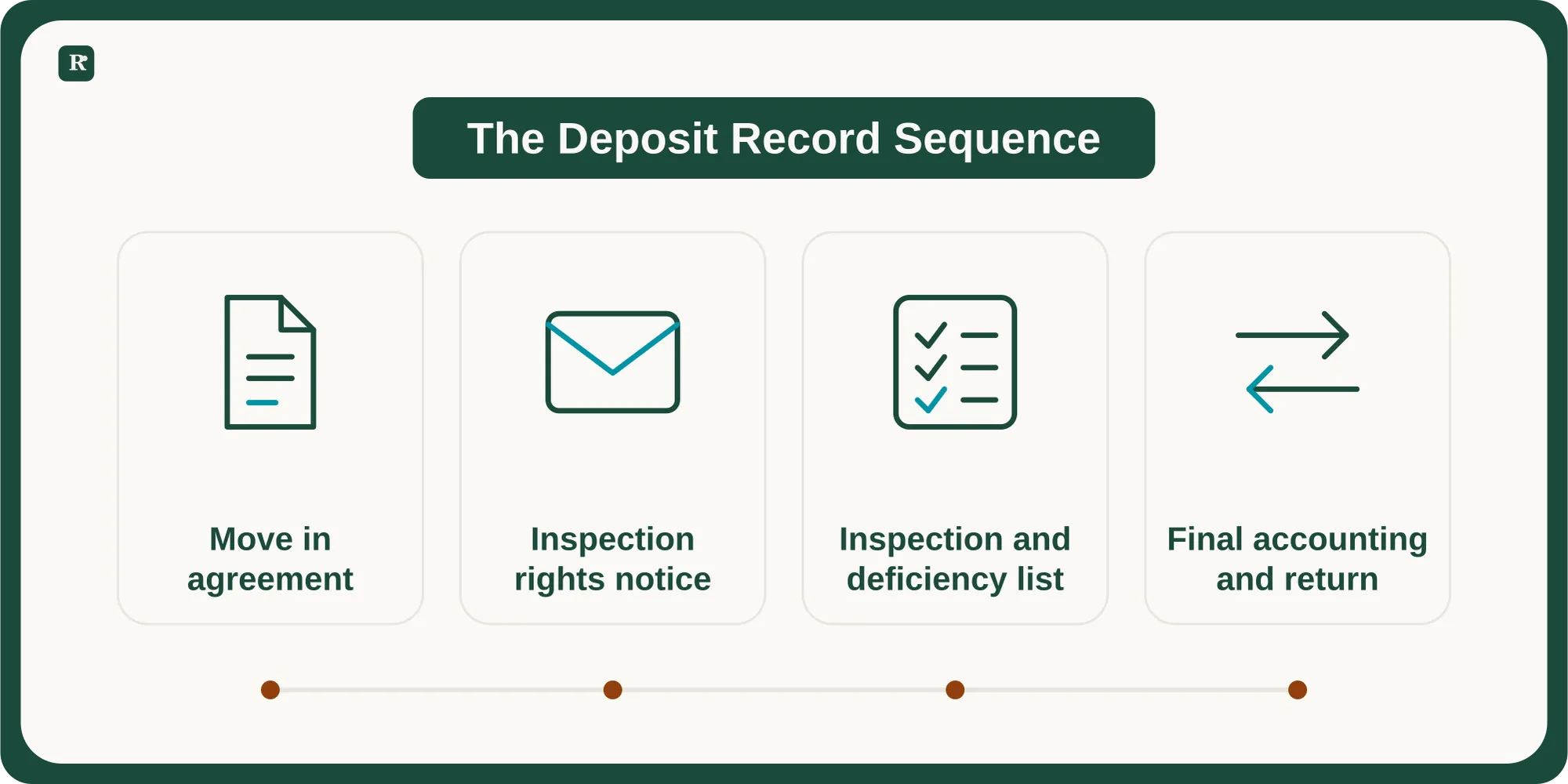 The article links these records across the tenancy.
Sources
Bracketed numbers point to the sources below. Where several numbers appear together, the statement is our reading across those sources.
- Under GOL Section 7-108(1-a)(a), for non-rent-stabilized residential dwelling units in New York, no security deposit or advance may exceed the amount of one month’s rent. https://www.nysenate.gov/legislation/laws/GOB/7-108
- Under GOL Section 7-108(1-a)(c), before the tenant begins occupancy the landlord must offer the tenant the opportunity to conduct a move-in inspection; https://www.nysenate.gov/legislation/laws/GOB/7-108
- Under GOL Section 7-108(1-a)(d), after either party gives notice of intent to terminate the tenancy, the landlord must notify the tenant in writing of the tenant’s right to request a pre-move-out inspection and the right to… https://www.nysenate.gov/legislation/laws/GOB/7-108
- Under GOL Section 7-108(1-a)(d), if the tenant requests a pre-move-out inspection, it must be scheduled no earlier than two weeks and no later than one week before the end of the tenancy, and the landlord must provide at… https://www.nysenate.gov/legislation/laws/GOB/7-108
- Under GOL Section 7-108(1-a)(e), the landlord must return any remaining portion of the deposit and provide an itemized statement within 14 days after the tenant has vacated the premises. https://www.nysenate.gov/legislation/laws/GOB/7-108
- Under GOL Section 7-108(1-a)(e), a landlord who fails to provide the itemized statement and return the deposit within 14 days forfeits any right to retain any portion of the deposit. https://www.nysenate.gov/legislation/laws/GOB/7-108
- Under GOL Section 7-108(1-a)(f), in any action or proceeding disputing the amount of the deposit retained, the landlord bears the burden of proof as to the reasonableness of the amount retained. https://www.nysenate.gov/legislation/laws/GOB/7-108
- Under GOL Section 7-108(1-a)(g), a landlord who willfully violates the security deposit provisions is liable for punitive damages of up to twice the amount of the deposit or advance, in addition to actual damages. https://www.nysenate.gov/legislation/laws/GOB/7-108
- Under GOL Section 7-108(1-a)(d), after the pre-move-out inspection the landlord must provide the tenant with an itemized statement specifying repairs or cleaning proposed as the basis for deductions, and the tenant must have… https://www.nysenate.gov/legislation/laws/GOB/7-108