
Key takeaways
- O.C.G.A. § 44-7-31 attaches three distinct duties the moment you collect a deposit: a qualifying escrow account, a trust-holding posture, and written location notice to the tenant. [1, 2]
- “Established only for that purpose” means the account’s sole function is holding tenant security deposits — your operating account does not qualify. [1]
- The deposit belongs to the tenant until you establish a lawful right to deduct from it; spending it before the tenancy ends is a trust violation under the statute. [1]
- A statutory alternative exists under § 44-7-32, but its conditions were not available for this article — do not rely on it without reading the current statutory text and confirming you qualify. [3]
- A fifteen-minute record at lease signing — account details, signed written notice, running ledger — is the document a court will ask for first.
Georgia’s security deposit statute is short but precise. O.C.G.A. § 44-7-31 imposes three distinct, non-delegable obligations on you the moment a deposit is collected: a qualifying account structure, a trust-holding duty, and a written location notice to the tenant. [1, 2] Getting any one of those wrong is the procedural defect a tenant’s attorney reads for first, before a dispute ever reaches the merits. This article works through each obligation in turn — account structure, trust-holding posture, and written notice — using the statutory text as the anchor, then explains the one statutory alternative you must understand before assuming the escrow path is your only option.
Obligation 1: Open a Dedicated Escrow Account at a Qualifying Institution
The escrow obligation under § 44-7-31 is unconditional on its face: it attaches the moment you hold a deposit. The statute does not say “a separate ledger” or “a labeled savings account.” It specifies an escrow account established only for that purpose.
Under O.C.G.A. § 44-7-31, whenever a security deposit is held by a landlord or the landlord’s agent on behalf of a tenant, that deposit must be placed in an escrow account established only for that purpose at any bank or lending institution subject to regulation by the state of Georgia or any agency of the United States government. [1]
“Only for that purpose” rules out your operating checking account, your personal savings account, and any commingled account that also holds rent receipts or maintenance reserves. [1]
If you manage more than one rental unit, the statute does not require a separate escrow account per tenancy. A single account can hold deposits from multiple tenancies, provided the account’s sole function remains holding those deposits and nothing else crosses that account’s ledger. [1]
The qualifying institution must be regulated by Georgia or a federal agency. [1] A mainstream commercial bank, a federally chartered credit union, or a federally insured savings institution each qualifies. If you are uncertain whether your institution qualifies, its federal charter or FDIC membership is the confirming check.
| Account type | Qualifies under O.C.G.A. § 44-7-31? [1] |
|---|---|
| Dedicated escrow account at an FDIC-insured commercial bank | Yes |
| Dedicated escrow account at a federally chartered credit union | Yes |
| Dedicated escrow account at a Georgia-regulated savings institution | Yes |
| Operating checking account at a qualifying bank | No — not established “only for that purpose” |
| Personal savings account at a qualifying bank | No — not established “only for that purpose” |
| Commingled account holding rent and deposits | No — not established “only for that purpose” |
Obligation 2: Hold the Money in Trust — Not as Your Own
Opening the correct account is necessary but not sufficient. § 44-7-31 separately imposes a trust-holding posture on how the money inside that account must be treated.
The deposit is held in trust for the tenant by the landlord or the landlord’s agent. [1] “In trust” has a plain operational meaning: the money belongs to the tenant until you establish a lawful right to deduct from it. Spending it on a repair before the tenancy ends, drawing from it to cover a rent shortfall, or treating it as a float you intend to restore later is a trust violation from the moment the funds leave the account — regardless of intent. [1]
Self-managing landlords who run lean sometimes use the deposit as a short-term reserve, fully intending to replenish it before move-out. That is the single most common fact pattern in Georgia deposit disputes. The trust-holding duty under § 44-7-31 makes the practice a statutory violation at the moment the balance dips below the sum of deposits held. [1]
The practical corollary is direct: document every transaction in and out of the escrow account with a date, amount, and stated reason. If a dispute arises, the account ledger is the first document produced in discovery. A ledger showing the balance never fell below the aggregate of all deposits held is the cleanest evidence that the trust duty was honored throughout the tenancy. [1]
Obligation 3: Deliver Written Notice of the Account’s Location
Holding the money correctly is still not sufficient. § 44-7-31 separately requires that the tenant be informed in writing of the location of the escrow account. [2]
This is a disclosure obligation that runs from you to the tenant — not an internal record-keeping step. [2] “Location” means the bank or institution holding the account: enough identifying information that the tenant could, in principle, verify that a dedicated account exists.
The statute frames the obligation in terms of the tenant being informed, not merely being informed once and never again. [2] If you move the deposit to a different institution mid-tenancy — because you switch banks, for example — the same disclosure logic applies. The tenant should know where their money is held at all times during the tenancy.
The most defensible approach is to deliver the written location notice at or before lease signing, make it a named exhibit in the lease, and retain a signed acknowledgment. That creates a dated, tenant-signed document showing you discharged the disclosure duty — exactly the kind of paper trail that forecloses a claim that the tenant was never told where their money was held.
The § 44-7-32 Alternative: Read It Before Assuming You Qualify
O.C.G.A. § 44-7-31 opens with an explicit carve-out: the escrow requirement does not apply when the conditions of § 44-7-32 are met. [3] Knowing that an alternative exists is part of understanding your obligations under the statute.
The full conditions of § 44-7-32 — including what instrument is required, what amounts or insurer standards apply, and what election procedure the landlord must follow — are not covered in this article. [3] The § 44-7-32 path is understood in practice to involve a surety bond, but the specific requirements are a matter for the current statutory text, not this summary.
That gap matters for your decision. If you believe you have satisfied the § 44-7-32 alternative and you have not, the escrow requirement under § 44-7-31 applies in full — and a procedural defect on the account structure runs from the first day of the tenancy. [1] The practical guidance is direct: unless you have read the current text of § 44-7-32 and confirmed with a Georgia-licensed attorney that you meet each condition, treat the escrow requirement as operative. Opening a dedicated escrow account at a qualifying bank is the default path the statute plainly describes. [1]
 A record binder links account history with retained notice records.
Three Obligations, One Record
The three obligations under § 44-7-31 are separable in law but linked in practice. A landlord who opens the right account, maintains the trust-holding posture throughout the tenancy, and delivers written notice to the tenant has satisfied the § 44-7-31 framework. [1, 2]
The record-keeping step that makes all three defensible is a file opened at or before lease signing. That file should contain:
- Escrow account details — institution name, account type, date opened, and account number (or last four digits).
- Signed written notice — the document delivered to the tenant disclosing the account’s location, with the tenant’s dated signature acknowledging receipt. [2]
- Running account ledger — a transaction log showing deposits received, the current balance, and any lawful deductions made at move-out, with the balance never falling below the aggregate deposits held during the tenancy. [1]
If a dispute arises, that file is the first thing your attorney will ask for and the first thing a tenant’s attorney will demand. Building it at lease inception costs fifteen minutes. Reconstructing it after a dispute is filed often costs far more.
FAQ
Does the escrow requirement apply if I only have one rental unit? O.C.G.A. § 44-7-31 does not carve out small landlords by unit count in the text available for this article. [1] The escrow obligation attaches when you hold a deposit — treat it as operative regardless of how many units you manage, and confirm the current statutory text directly.
Can the tenant’s deposit sit in my regular bank account if it is at a qualifying institution? No. The statute requires an account established only for that purpose. [1] A qualifying institution is necessary but not sufficient — the account itself must be dedicated solely to holding tenant security deposits.
What if I want to use the § 44-7-32 surety-bond alternative instead? Read the current text of § 44-7-32 and confirm with a Georgia-licensed attorney that you meet each condition before relying on it. [3] If you do not qualify and have not opened a dedicated escrow account, the escrow requirement under § 44-7-31 applies from the first day you held the deposit. [1]
When must I deliver the written location notice to the tenant? The statute requires the tenant to be informed in writing of the account’s location but does not specify a delivery deadline or method in the text available for this article. [2] Delivering and documenting the notice at lease signing is the most defensible practice.
Reach move-out with a file that answers every procedural question before it is asked: the right account, the right ledger, the right notice, all documented from day one.
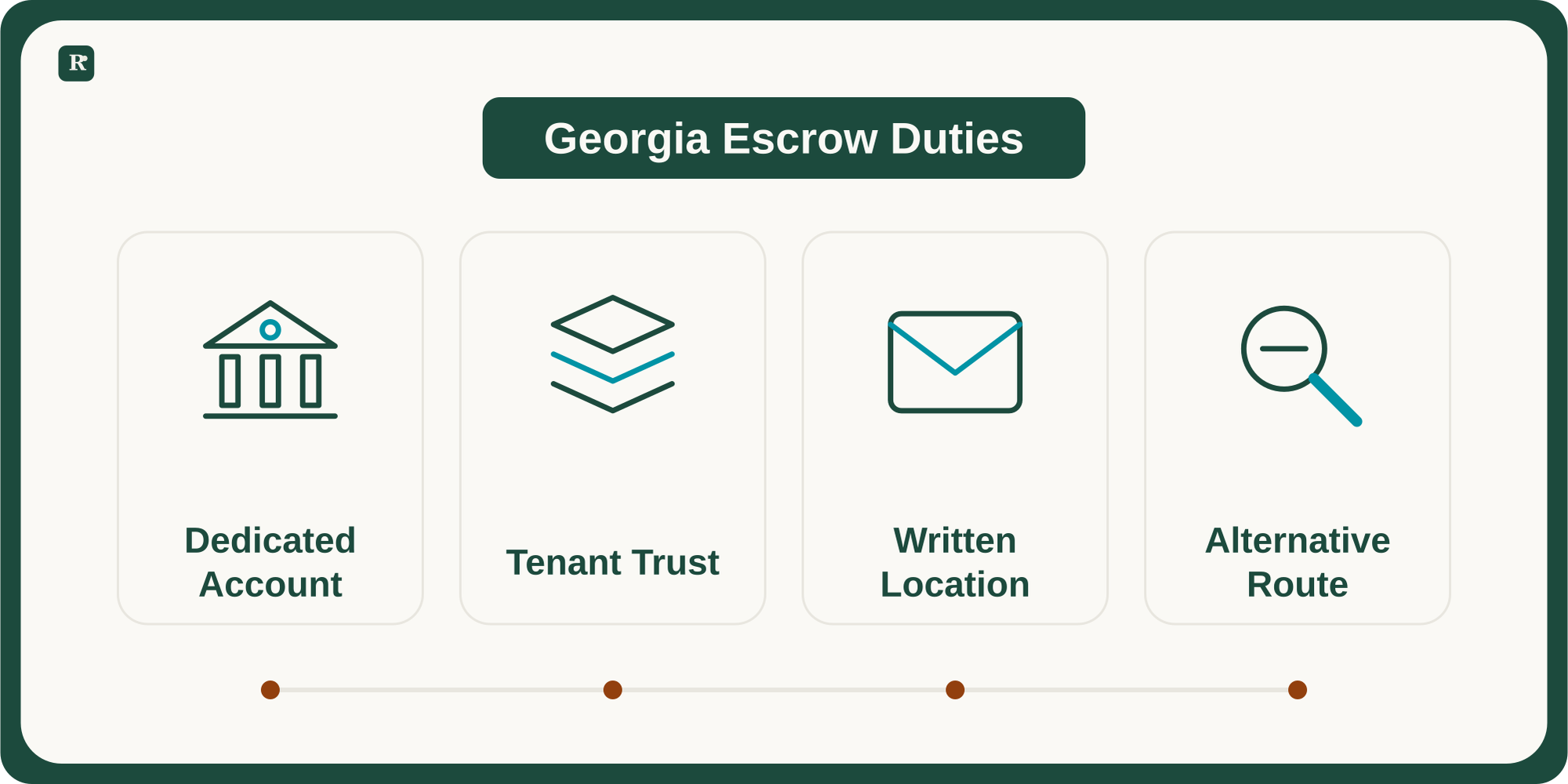 Georgia — O.C.G.A. § 44-7-31; alternative referenced in § 44-7-32. Last-checked date: not supplied. Render the alternative card with a dashed border; its conditions require review by a Georgia-licensed attorney.
Sources
Bracketed numbers point to the sources below. Where several numbers appear together, the statement is our reading across those sources.
- Under O.C.G.A. § 44-7-31, a landlord holding a security deposit must deposit it in an escrow account established only for that purpose at a bank or lending institution regulated by Georgia or a federal agency, and must… https://codes.findlaw.com/ga/title-44-property/ga-code-sect-44-7-31.html
- Under O.C.G.A. § 44-7-31, the landlord must inform the tenant in writing of the location of the escrow account. https://codes.findlaw.com/ga/title-44-property/ga-code-sect-44-7-31.html
- O.C.G.A. § 44-7-31 contains an exception: the escrow-account requirement does not apply when the conditions of § 44-7-32 are met, which provides an alternative (understood in practice to be a surety bond), but the text… https://codes.findlaw.com/ga/title-44-property/ga-code-sect-44-7-31.html